A Mazda tailshaft repair in Kirrawee often comes down to one thing: a component that’s designed to last a long time, but when it does fail, you’ll feel it immediately. The tailshaft (also called a propeller shaft or driveshaft) transfers engine power from the gearbox to the rear axle. When it develops wear, damage, or imbalance, your Mazda will tell you clearly. We’ve seen everything from worn universal joints to bent shafts come through our workshop, and the sooner you address the problem, the less chance you have of being stranded or causing further damage to the rear differential.
Signs Your Mazda Tailshaft Needs Inspection
The most obvious warning is a clunking noise when you accelerate or decelerate, particularly noticeable in older Mazda models with higher mileage. You might also feel vibration through the floor at certain speeds, especially between 80 and 100 kilometres per hour. Some Mazda owners describe it as a rhythmic shudder that gets worse when the car is under load.
- Clunking or banging sound from underneath, especially during gear changes
- Vibration felt through the cabin floor or steering wheel at highway speeds
- A grinding or scraping noise that changes pitch with vehicle speed
- Loss of power delivery or difficulty accelerating smoothly
- Visible damage to the shaft or rubber coupling (U-joint boot) during inspection
Don’t ignore these signs. A deteriorating tailshaft can eventually lock up completely, leaving you without rear-wheel drive or stranded. If bearings are failing, metal debris can contaminate the rear differential oil, turning a tailshaft repair into a much more expensive differential rebuild.
How We Diagnose and Repair Mazda Tailshaft Issues
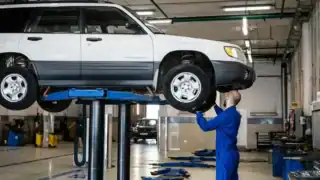
We start with a visual inspection under the vehicle, checking for obvious damage, play in the shaft, and condition of the universal joints and rubber couplings. For Mazda vehicles, we follow the manufacturer’s diagnostic procedure to identify whether the issue is a worn universal joint, shaft imbalance, bearing failure, or a bent shaft caused by impact or pothole damage.
Next, we test the shaft for run-out (sideways movement) using precision equipment. This tells us whether the shaft can be repaired or needs replacement. We also check the rubber coupling mounts and carrier bearing, which are common wear points on Mazda tailshafts, especially on higher-mileage models.
Once we’ve identified the fault, you’ll get a clear explanation of what’s needed. Some repairs involve replacing individual components like universal joints or the carrier bearing. Other times, the entire shaft needs to be replaced with a genuine Mazda tailshaft or a quality equivalent that meets OEM specifications. We’ll discuss both options with you, including any cost difference, so you can make an informed choice.
Installation is straightforward for most Mazda models, but we pay attention to alignment and torque specifications. A poorly installed tailshaft can create new vibration issues or cause premature wear on the new components.
What Affects Cost and Repair Time for Tailshaft Work
The main variables are whether we’re replacing individual universal joints or the entire shaft, parts availability, and your Mazda model. Some older or less common Mazda variants may require ordering parts, which extends the timeline. Newer models often have parts in stock or available quickly through our supplier network.
Labour time also varies. A straightforward universal joint replacement might take a few hours. A full tailshaft replacement, including removal, reinstallation, and balancing, typically takes longer. We’ll give you a timeframe once we’ve completed the inspection and sourced parts.
We use genuine Mazda parts where practical, because they’re engineered to match your vehicle’s specifications and protect your warranty. Where OEM parts are unavailable or significantly more expensive, we’ll recommend a quality aftermarket alternative that meets Mazda’s standards, always with your approval first.
Why Local Mazda Owners in Kirrawee Choose Shire Tune & Service
Mazda vehicles are common in Kirrawee and across the Shire, and we’ve been servicing them for over 18 years. Our diagnostic equipment allows us to identify tailshaft faults accurately, so you’re not guessing or paying for unnecessary replacements. We’re experienced with the typical wear patterns on Mazda 3s, Mazda 6s, CX-5s, and other models, so diagnosis is faster and more reliable.
You get honest advice, not upselling. If a universal joint can be replaced instead of the whole shaft, we’ll tell you. If you genuinely need a new tailshaft, we’ll explain why. Over 30 years in the trade means we’ve learned what actually needs fixing and what’s preventive overthinking. Fair pricing and transparent communication are the foundation of how we work.
We’ll also make sure any tailshaft work doesn’t affect your Mazda’s warranty. Logbook servicing through us is fully recognised by Mazda, and genuine or OEM-equivalent parts protect your coverage.
Book Your Mazda Tailshaft Inspection in Kirrawee
If you’re hearing clunking from underneath, feeling vibration, or suspect tailshaft wear, Call Us Today or Book Your Free Inspection online. We’ll get to the root of the problem and let you know exactly what’s needed, with no surprises.