When your Suzuki’s air conditioning stops blowing cold, the whole driving experience changes. A working air conditioning system isn’t a luxury in Australian summers—it’s part of keeping you and your passengers comfortable and safe on longer journeys. Suzuki car air conditioning relies on a sealed refrigerant circuit, compressor, and condenser working together, and when any part fails, the system stops cooling. We service Suzuki vehicles regularly across Kirrawee and the Sutherland Shire, and air conditioning repairs are among the most common jobs we handle. Understanding what’s happening inside your system helps you make better decisions about repair timing and cost.
Common Signs Your Suzuki’s Air Conditioning Needs Attention
Most Suzuki owners notice air conditioning problems gradually. You might turn on the AC and feel only slightly cool air instead of the cold blast you’re used to. The system might work fine when you first start driving but lose cooling power after 10 or 15 minutes. Some customers report that the AC only cools when the vehicle is moving, but fails when stationary at traffic lights. These are all classic signs of refrigerant loss or compressor wear.
- Warm air blowing from the vents even when AC is set to maximum cooling
- Weak airflow or reduced volume of air from the dashboard vents
- Hissing or bubbling sounds from under the bonnet when the compressor runs
- Oil stains or residue around hose connections and fittings
- AC odours—musty, sour, or chemical smells coming through the vents
- Compressor cycles on and off rapidly, rather than running smoothly
- Visible refrigerant leaks or oily residue on air conditioning components
Refrigerant leaks are the most common issue we see in Suzuki vehicles. Even tiny leaks reduce system pressure until the compressor can’t build enough force to cool the air. Leaks often develop at hose fittings, the condenser, or where the evaporator sits inside the dash. Diagnosing exactly where the refrigerant is escaping requires proper equipment—we don’t guess and throw parts at the problem.
How We Diagnose and Service Suzuki Air Conditioning Systems
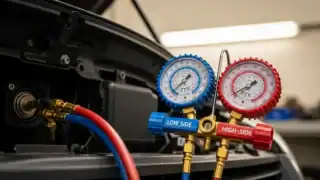
Air conditioning diagnostics for Suzuki vehicles starts with pressure testing. We connect gauges to the high-pressure and low-pressure ports of your system and read the actual refrigerant charge. A properly charged Suzuki AC system will show specific pressures depending on ambient temperature and compressor load. If those readings are low, we know there’s a leak somewhere, and we use UV dye and electronic leak detection tools to pinpoint the exact location. This methodical approach saves money by identifying the real problem before you pay for parts.
Once we’ve diagnosed the issue, the repair process depends on what we’ve found. If it’s a slow refrigerant leak from a hose connection, we may replace that hose, flush the system, and recharge with fresh Suzuki-specification refrigerant. If the condenser is blocked or damaged, we replace it. If the compressor has failed mechanically, replacement is the only reliable fix. Every Suzuki model has slightly different compressor types and refrigerant requirements, so we always check Suzuki’s technical documentation to ensure we use the correct parts and refrigerant type.
The service also includes cleaning or replacing the cabin air filter, which affects how efficiently cool air flows through your vents. A blocked filter forces your AC to work harder and reduces the cooling you feel. We inspect the condenser for debris, leaves, or insect nests that can reduce heat exchange, especially if you’ve been driving in dusty Shire conditions. If the system is contaminated with moisture or debris, we perform a full flush before recharging.
What Affects Your Air Conditioning Repair Cost and Timeline
Several factors influence how much a Suzuki air conditioning repair will cost. The first is what’s actually broken. A simple refrigerant top-up and leak repair costs far less than replacing a failed compressor. The location of the leak matters too—a leaking hose fitting is straightforward; a condenser leak buried in the front of the radiator takes longer to access. The year and model of your Suzuki also affects parts availability and labour time. Newer models often have more complex compressor designs, while older Suzuki air conditioning systems can be simpler to work on.
We use genuine Suzuki-equivalent refrigerant and OEM-specification parts wherever possible. This protects the integrity of your air conditioning system and ensures it runs as the manufacturer intended. We’ll always explain your parts options before we start work, so you know whether we’re using genuine components or quality aftermarket equivalents. Turnaround time depends on what needs replacing—a refrigerant recharge can be done in under an hour, but a compressor replacement may take a full working day. Parts availability occasionally requires a wait, but we’ll let you know upfront.
Why Shire Tune & Service for Your Suzuki Air Conditioning in Kirrawee
We’ve spent over 30 years working on vehicles across the Sutherland Shire, with 18 years servicing Kirrawee specifically. Japanese vehicle specialists like Suzuki are part of our core focus, and we invest in the diagnostic equipment needed to service them properly. Our pressure gauges, leak detection tools, and refrigerant recovery units are up to current standards, which means we diagnose accurately and avoid unnecessary parts replacement. We won’t upsell you into repairs you don’t need—our reputation depends on honest advice and transparent pricing.
Every air conditioning service we perform uses genuine parts that keep your Suzuki’s warranty intact. We don’t cut corners with low-grade refrigerant or cheap hose fittings. Your car will cool properly, and it will stay cool because we’ve diagnosed the actual problem and fixed it right the first time. With our 5.0 verified reviews, you can trust that the work we do matches our word.
Book Your Suzuki Air Conditioning Service in Kirrawee Today
If your Suzuki isn’t cooling the way it should, don’t wait until summer hits hard. Call Us Today to describe what’s happening, or Book Your Free Inspection online. We’ll diagnose the problem, explain your options, and get you back on the road with cold air and confidence.